The Growing Epidemic of Knee Pain & Osteoarthritis in Mira Road
Chronic knee pain is one of the most widespread musculoskeletal complaints affecting residents across Mira Road, Bhayandar, and Dahisar. From senior citizens experiencing excruciating morning stiffness in localities like Shanti Park and Poonam Sagar, to middle-aged professionals whose knees click and ache after climbing apartment stairs or walking along Mira Bhayandar Road, knee joint degeneration significantly impairs daily independence.
The anatomical trigger in the majority of adults over 45 is knee osteoarthritis (OA)—a progressive degeneration of the shock-absorbing articular cartilage lining the tibiofemoral and patellofemoral joints. As cartilage wears down, joint space narrows, causing bone-on-bone friction, painful inflammation (synovitis), joint crepitus (grating sounds), and debilitating bone spurs (osteophytes).
However, receiving a diagnosis of knee osteoarthritis does not mean you are destined for immediate, invasive surgery. Consulting a top
knee physiotherapist in Mira Road or searching for a trusted
knee physiotherapist near me allows over 80% of patients with Grade 1, 2, and 3 osteoarthritis to eliminate pain, rebuild joint stability, and avoid joint replacement through advanced physical rehabilitation.
Clinical Stages of Knee Osteoarthritis & When Surgery Can Be Avoided
Understanding your radiographic grade (from an X-ray or MRI) is crucial for selecting the appropriate treatment protocol:
- Grade 1 (Doubtful): Minimal cartilage wear with tiny osteophytes. Symptoms: occasional mild aching after prolonged standing or fast walking. Resolution: 100% manageable with 3–4 weeks of corrective physiotherapy.
- Grade 2 (Mild): Discernible osteophytes with mild joint space narrowing. Symptoms: stiffness after sitting, discomfort walking down stairs. Resolution: Highly responsive to non-surgical manual therapy and quad retraining.
- Grade 3 (Moderate): Marked joint space narrowing, cartilage fragmentation, and noticeable bone contour deformity. Symptoms: pain with everyday walking, recurrent swelling, joint crepitus. Resolution: Targeted clinical decompression, Class 4 laser, and hip-knee kinematic correction delay or completely eliminate the need for surgery.
- Grade 4 (Severe): Complete loss of joint space (bone-on-bone contact) with large osteophytes and severe deformity (varus bow-leggedness). Resolution: While surgical Total Knee Replacement (TKR) is frequently recommended, comprehensive pre-habilitation significantly speeds up post-surgical recovery.
Why Painkillers & Injections Provide Only Temporary Relief
When knee pain becomes intense, many patients rely on oral non-steroidal anti-inflammatory drugs (NSAIDs) or intra-articular steroid injections. While these interventions dampen biochemical pain signals temporarily, they do not repair mechanical joint dysfunction.
In fact, repeatedly masking pain without correcting faulty biomechanics often accelerates joint destruction: patients continue walking with poor alignment, grinding degraded cartilage without warning signals. True long-term healing requires correcting patellar tracking, restoring joint lubrication through gentle mechanical motion, and strengthening the surrounding shock-absorbing musculature.
Dr. Ruman Mallick's 5-Pillar Non-Surgical Knee Protocol
At our specialized clinics—located at Arogya Clinic (Behind Rassaz Mall) and Imperial Tower 2 (Vinay Nagar)—Dr. Ruman Mallick utilizes a proprietary 5-pillar non-surgical knee rehabilitation framework:
Pillar 1: Patellofemoral & Tibiofemoral Manual Mobilization
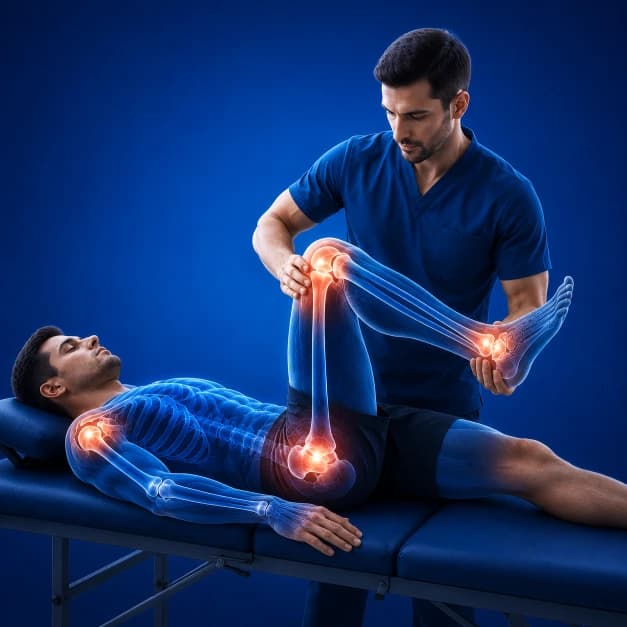
Using certified Mulligan Concept (Mobilisation with Movement) and Maitland techniques, Dr. Mallick gently mobilizes the patella (kneecap) in superior, inferior, and medial directions. This relieves patellar compression, breaks up capsular adhesions, and immediately restores pain-free joint gliding.
Pillar 2: Class 4 High-Intensity Laser & Targeted Electrotherapy
Deep-penetrating photonic energy from Class 4 Laser therapy reaches into the intra-articular synovial membrane. This accelerates cellular ATP synthesis, flushes out inflammatory cytokines, and stimulates natural synovial fluid production to re-lubricate the knee joint.
Pillar 3: Selective Vastus Medialis Oblique (VMO) & Quadriceps Retraining
The vastus medialis oblique (VMO) is the teardrop-shaped inner quad muscle responsible for stabilizing the patella during knee extension. In arthritic knees, the VMO atrophies rapidly. We utilize biofeedback and closed-kinetic-chain exercises (terminal knee extensions, wall squats with gym balls, isometric quad sets) to re-engage the VMO without causing patellofemoral grinding.
Pillar 4: Hip Abductor & Gluteus Medius Stabilization
Knee pain rarely starts solely in the knee. Weakness in the hip abductors (gluteus medius) causes the femur to collapse inward (dynamic valgus) during every walking step, exerting massive torsional stress on the medial knee compartment. Strengthening the hip musculature acts like an external shock absorber, offloading up to 30% of the mechanical pressure on your knee joint.
Pillar 5: Custom Gait Correction & Footwear Ergonomics
We analyze your standing posture and walking stride to detect overpronation or limb length discrepancies. Recommending supportive medial arch insoles and footwear modifications ensures your joint alignment remains protected during daily activities.
Comprehensive Post-Total Knee Replacement (TKR) Rehabilitation
For patients who have undergone Total Knee Replacement (TKR) surgery at multi-specialty hospitals like Wockhardt, Bhaktivedanta, or Meditech, early post-operative rehabilitation is crucial for preventing joint stiffness and scar tissue arthrofibrosis:
- Weeks 1–2 (Early Phase): Passive Continuous Passive Motion (CPM) therapy, cryotherapy for effusion control, active ankle pumps for DVT prevention, and achieving 0-degree full knee extension.
- Weeks 3–6 (Intermediate Phase): Progressive knee flexion drills (targeting 110° to 120° ROM), weaning off the walker to a single stick, and closed-chain weight-bearing balance retraining.
- Weeks 7–12 (Advanced Functional Phase): Independent stair climbing (step-over-step), stationary cycling, and functional outdoor walking without assistive devices.
Patient Success: Avoiding Knee Surgery at Age 58
Mrs. Sunita K., a 58-year-old homemaker from Beverly Park, Mira Road, was diagnosed with bilateral Grade 3 knee osteoarthritis. She struggled to climb the single flight of stairs to her apartment and could not stand for more than 10 minutes in her kitchen. Orthopaedic surgeons recommended bilateral knee replacement surgery.
Sunita consulted Dr. Ruman Mallick at Arogya Clinic for conservative management. Over an 8-week structured rehabilitation program consisting of patellar mobilization, Class 4 Laser therapy, gluteal strengthening, and non-impact quad conditioning, her knee pain score dropped from 8/10 to 1/10. Today, she walks 3 kilometers every morning at GCC Club jogging track and manages all household activities completely pain-free without surgery.